Waking the Buddha by Clark Strand
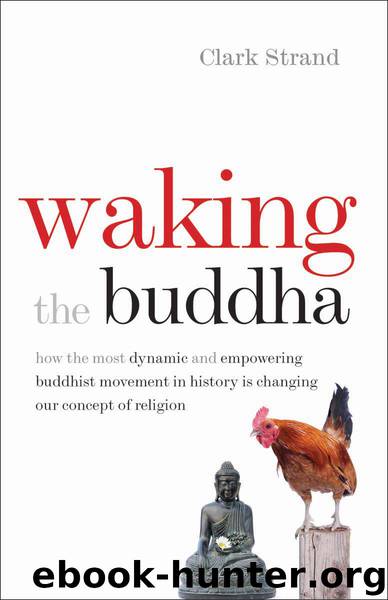
Author:Clark Strand
Language: eng
Format: epub
Publisher: Middleway Press
Published: 2014-04-12T04:00:00+00:00
passing the flame of reform
TODA’S HEALTH deteriorated rapidly in the months following his anti-nuclear declaration until his death in a Tokyo hospital on April 2, 1958. But his diminished vitality seemed to sharpen his resolve. In his final decisions as leader of the Soka Gakkai we can find a much more discerning sense of mission, as though certain problems had become perfectly clear to him only with his passing of the torch.
The first was his decision to remove those Soka Gakkai leaders who routinely used the organization for their own monetary benefit. In the early days, some leaders took advantage of their influence among a rapidly growing membership to peddle insurance policies and other goods and services. The sheer size of the Soka Gakkai, Toda observed, virtually ensured that it would attract a certain number of parasites who, if left unchecked, would devour the organization from within. The second was to eliminate the system of allowing “courtesy positions” to certain individuals, rather than awarding such leadership roles based on effort and ability. These recommendations were instantly followed, resulting in the dismissal of forty-six leaders on March 28, less than a week before Toda’s death.
These were reasonable recommendations that came as a relief to most of the members. But their real significance lies in the fact that both were safeguards against stagnation. Having passed the flame of the Soka Gakkai’s teachings on to its younger members, Toda was concerned about any problems within the organization that might lead to it going out. For there are only two ways a candle flame can be extinguished. The first is when a wind or some other force acts upon it. Toda had taken precautions against this already by building a very strong “housing” for his flame in the structure of the Soka Gakkai itself. The second was more dangerous, however, and far more insidious. That is because it simply involved letting the candle continue to burn. For even if no other force acted against it, eventually the wax would be exhausted, and the candle would go out. The only protection against this second danger was continuous outreach—spreading the teaching to others, “even to the fiftieth person,” to see how far it would go. The flame must be continuously passed along.
It was this last problem that Toda wrestled with and sought to address by ensuring that the Soka Gakkai leadership would remain actively involved in spreading the teachings of Nichiren Buddhism instead of degenerating into a commercial or authoritarian structure—a destiny that is almost inevitable in religious organizations of a certain size, unless measures are taken to prevent it. Sharing the practice with others was already integral to Nichiren Buddhism; thus Toda felt doubly justified in making it the principal aim of the Soka Gakkai going forward. But it served a practical purpose as well. Toda’s genius lay in the bringing together of just these two considerations—the spiritual and the practical—and joining them as one. His spiritual journey may have had its beginning in the
Download
This site does not store any files on its server. We only index and link to content provided by other sites. Please contact the content providers to delete copyright contents if any and email us, we'll remove relevant links or contents immediately.
The Way of Zen by Alan W. Watts(6614)
Ego Is the Enemy by Ryan Holiday(5446)
The Art of Happiness by The Dalai Lama(4130)
The Book of Joy by Dalai Lama(3986)
Why Buddhism is True by Robert Wright(3452)
Spark Joy by Marie Kondo(3302)
Shift into Freedom by Loch Kelly(3197)
Happiness by Matthieu Ricard(3047)
A Monk's Guide to a Clean House and Mind by Shoukei Matsumoto(2915)
The Lost Art of Good Conversation by Sakyong Mipham(2654)
The Meaning of the Library by unknow(2571)
The Unfettered Mind: Writings from a Zen Master to a Master Swordsman by Takuan Soho(2311)
The Third Eye by T. Lobsang Rampa(2266)
Anthology by T J(2211)
Red Shambhala by Andrei Znamenski(2199)
The Diamond Cutter by Geshe Michael Roach(2059)
Thoughts Without A Thinker: Psychotherapy from a Buddhist Perspective by Epstein Mark(2025)
Twilight of Idols and Anti-Christ by Friedrich Nietzsche(1893)
Advice Not Given by Mark Epstein(1880)
